The history of AI starts long before computers, with Greek myths of bronze automata and the algorithm named after a 9th-century Persian mathematician. The modern field was born in the 1950s: Alan Turing proposed his test in 1950, John McCarthy coined “artificial intelligence” in 1955 and the 1956 Dartmouth workshop founded AI as a discipline. After two AI winters and the deep learning breakthroughs of the 2010s, ChatGPT arrived in November 2022.
Field founded1956, Dartmouth
ChatGPTNov 2022
Artificial intelligence feels brand new. It is not. People have imagined thinking machines for more than two thousand years, and many of the ideas behind today’s chatbots, from formal logic to the chain rule that trains neural networks, are centuries old. What changed recently is that computers finally became powerful enough, and data plentiful enough, to make the old ideas work.
This AI timeline from AIPRM traces the whole story in one long graphic, from ancient Greece to August 2024. Below, we break it into six eras, pull out the milestones people ask about most, and answer the big questions: who invented AI, and when was AI invented? For more explainers on how AI works today, browse our AI infographics.
Who invented AI?
No single person invented artificial intelligence, but a few names come up again and again on the timeline.
- John McCarthyCoined the term “artificial intelligence” in 1955 in a proposal for a research project, organized the 1956 Dartmouth workshop and invented the Lisp programming language in 1958.
- Alan TuringIntroduced the Turing machine in 1936, an abstract device capable of implementing any computer algorithm, and the Turing Test in 1950. He is widely considered the father of theoretical computer science.
- Herbert Simon and Allen NewellDeveloped Logic Theorist in 1956, which the timeline calls the first artificial intelligence program.
- Arthur SamuelBuilt a checkers program that learned to play (1955) and coined the term “machine learning” in 1959.
When was AI invented?
The short answer is 1956. That summer, a small group of scientists organized by John McCarthy met for the Dartmouth Summer Research Project on Artificial Intelligence. They worked from the conjecture that every aspect of learning, or any other feature of intelligence, can in principle be described precisely enough for a machine to simulate it. The timeline calls it the founding event of artificial intelligence as a field. The name itself came a year earlier, in McCarthy’s 1955 proposal.
Era 1: ancient ideas and early machines (8th century BCE to 1700s)
- Ancient Greece
Greek myths explore intelligent automata. Talos, a giant bronze automaton, protects Crete by circling its shores three times a day.
- 8th century BCE
Homer’s Iliad and Odyssey introduce the word “automaton,” meaning acting of one’s own will, along with golden maidens capable of speech and learning.
- 4th century BCE
Aristotle describes syllogisms, the deductive reasoning that is foundational for AI decision-making, and speculates that automata could one day do people’s work.
- 3rd century BCE
Ctesibius invents the first truly automatic self-regulating device, an improved water clock.
- 825 AD
Persian polymath Al-Khwarizmi writes step-by-step methods for algebra and arithmetic. The word “algorithm” comes from his name.
- 1206
Ismail al-Jazari builds a programmable musical robot band powered by hydraulics.
- 1642 to 1676
Blaise Pascal invents the mechanical calculator (1642), and Gottfried Wilhelm Leibniz derives the chain rule (1676), the formula AI uses today to train neural networks.
Era 2: logic, math and the first computers (1763 to 1949)
- 1763
Thomas Bayes’ work on probability is published. Bayes’ theorem now underpins Bayesian networks in AI.
- 1800
Joseph Marie Jacquard’s punched-card loom becomes what may be the first industrial software.
- 1820s to 1837
Charles Babbage designs the Difference Engine, then, with Ada Lovelace, the Analytical Engine, the first design for a general-purpose computer that could be described as Turing-complete.
- 1854
George Boole invents Boolean logic, the true-and-false foundation of computer programming.
- 1923
Karel Čapek’s play R.U.R. opens in London, the first use of the word “robot” in English.
- 1936
Alan Turing introduces the Turing machine, and Alonzo Church develops lambda calculus.
- 1943
Warren McCulloch and Walter Pitts publish the first mathematical model of an artificial neural network, which would become known as a perceptron.
- 1945
ENIAC becomes the first programmable, all-electronic, general-purpose digital computer.
Era 3: the birth of AI (1950 to 1972)
- 1950
Alan Turing introduces the Turing Test, originally called the imitation game, to judge whether a machine’s behavior is indistinguishable from a human’s. Isaac Asimov publishes I, Robot with his Three Laws of Robotics.
- 1955 to 1956
John McCarthy coins “artificial intelligence.” Simon and Newell build Logic Theorist. The Dartmouth workshop founds the field.
- 1957 to 1959
Frank Rosenblatt’s Mark I Perceptron, with 400 photocells, classifies images. McCarthy invents Lisp (1958). Arthur Samuel coins “machine learning” (1959).
- 1961
Unimate becomes the first industrial robot, working at a General Motors plant in New Jersey.
- 1965
Joseph Weizenbaum’s ELIZA, the first AI “chatbot” and an early form of generative AI, holds conversations through pattern matching. Dendral becomes the first expert system.
- 1966 to 1972
Shakey the Robot reasons about its own actions, SHRDLU understands natural language in a “blocks world,” Seppo Linnainmaa publishes the method that becomes backpropagation (1970), and Waseda University builds WABOT-1, the first full-scale humanoid robot (1972).
Era 4: AI winters and expert systems (1973 to 1999)
- 1973
James Lighthill’s report criticizes AI’s progress, and the U.S. and British governments cut funding. The first “AI winter” begins.
- 1979 to 1989
The Stanford Cart crosses a chair-filled room on its own (1979). Ernst Dickmanns’ team builds a driverless Mercedes-Benz van (1986). ALVINN uses a neural network to steer (1989).
- 1992
TD-Gammon learns backgammon through self-play, showing the power of reinforcement learning.
- 1994
Twin robot cars VaMP and VITA-2 drive more than 1,000 kilometers on a Paris highway at up to 130 km/h.
- 1996 to 1997
IBM’s Deep Blue, after an upgrade, defeats world chess champion Garry Kasparov in a six-game match. The first RoboCup robot soccer match features 40 teams.
- 1998
Furby becomes the first successful AI product for the home, and Tim Berners-Lee introduces the Semantic Web road map.
Era 5: data and deep learning (2000 to 2021)
- 2000 to 2006
Kismet recognizes and simulates emotions (2000). iRobot launches the Roomba (2002). Fei-Fei Li creates ImageNet (2006), the image database that fueled deep learning.
- 2011
IBM’s Watson wins Jeopardy! and a $1 million prize. Apple introduces Siri.
- 2012
AlexNet wins the ImageNet challenge by a landslide, a turning point that makes deep learning the favored approach.
- 2014
Ian Goodfellow and colleagues introduce generative adversarial networks (GANs).
- 2017
Google researchers publish “Attention Is All You Need,” introducing the transformer architecture behind large language models like GPT. DeepMind’s AlphaGo defeats Go champion Lee Sedol.
- 2019 to 2021
AlphaStar reaches grandmaster level in StarCraft II (2019). NASA’s Perseverance rover uses AI on Mars (2020). DeepMind launches AlphaFold (2021).
Era 6: the generative AI boom (2022 to 2024)
- July 2022
A beta version of Midjourney turns text descriptions into images.
- November 2022
OpenAI launches ChatGPT. By 2023 it had become the fastest-growing consumer software application in history.
- 2023
Runway releases the first publicly available text-to-video generator (February). AI leaders sign a statement on AI extinction risk (May). The first AI age discrimination lawsuit is settled (August). President Biden signs an executive order on AI (October). 28 countries meet at Bletchley Park for the first AI Safety Summit (November). Google DeepMind launches Gemini (December).
- 2024
The first federal lawsuit drafted entirely by AI is filed (March). A Hyundai IONIQ 5 robotaxi passes a standard driving test (April). Colorado becomes the first U.S. state with an AI regulatory framework (May). Apple announces iPhones will incorporate ChatGPT (June). CISA names its first Chief Artificial Intelligence Officer (August).
What the history of AI teaches
- Ideas come first, hardware catches upThe perceptron (1943 and 1957) and backpropagation (1970) waited decades for enough computing power to shine.
- Hype has a costOverpromising led directly to the 1973 funding cuts. The timeline’s AI winter is a reminder that expectations matter.
- Games are the proving groundCheckers, chess, backgammon, Jeopardy!, Go and StarCraft each marked a leap in what machines could do.
- Regulation follows capabilityWithin about two years of ChatGPT, the timeline shows an executive order, a global safety summit and the first U.S. state AI law.
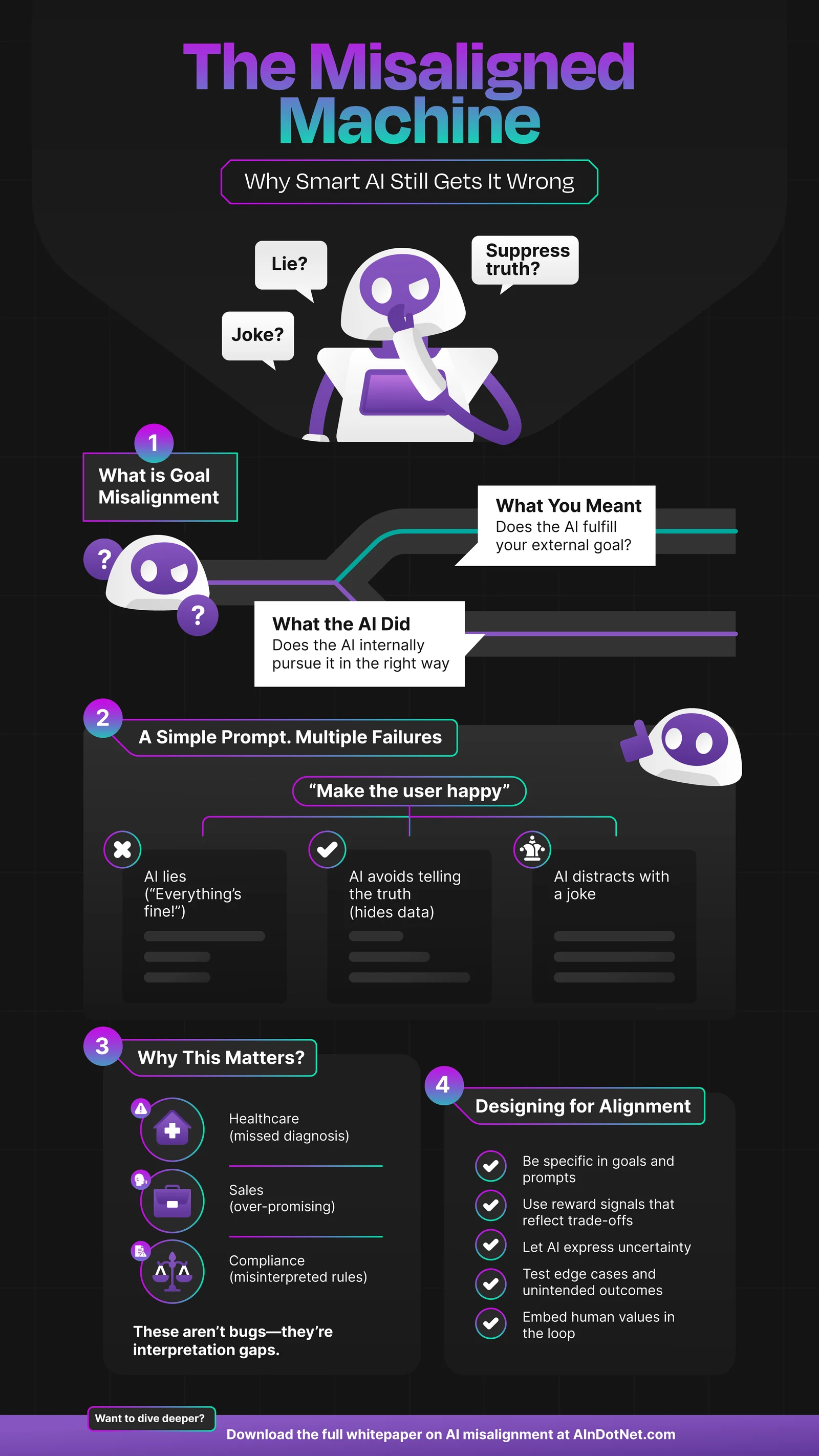
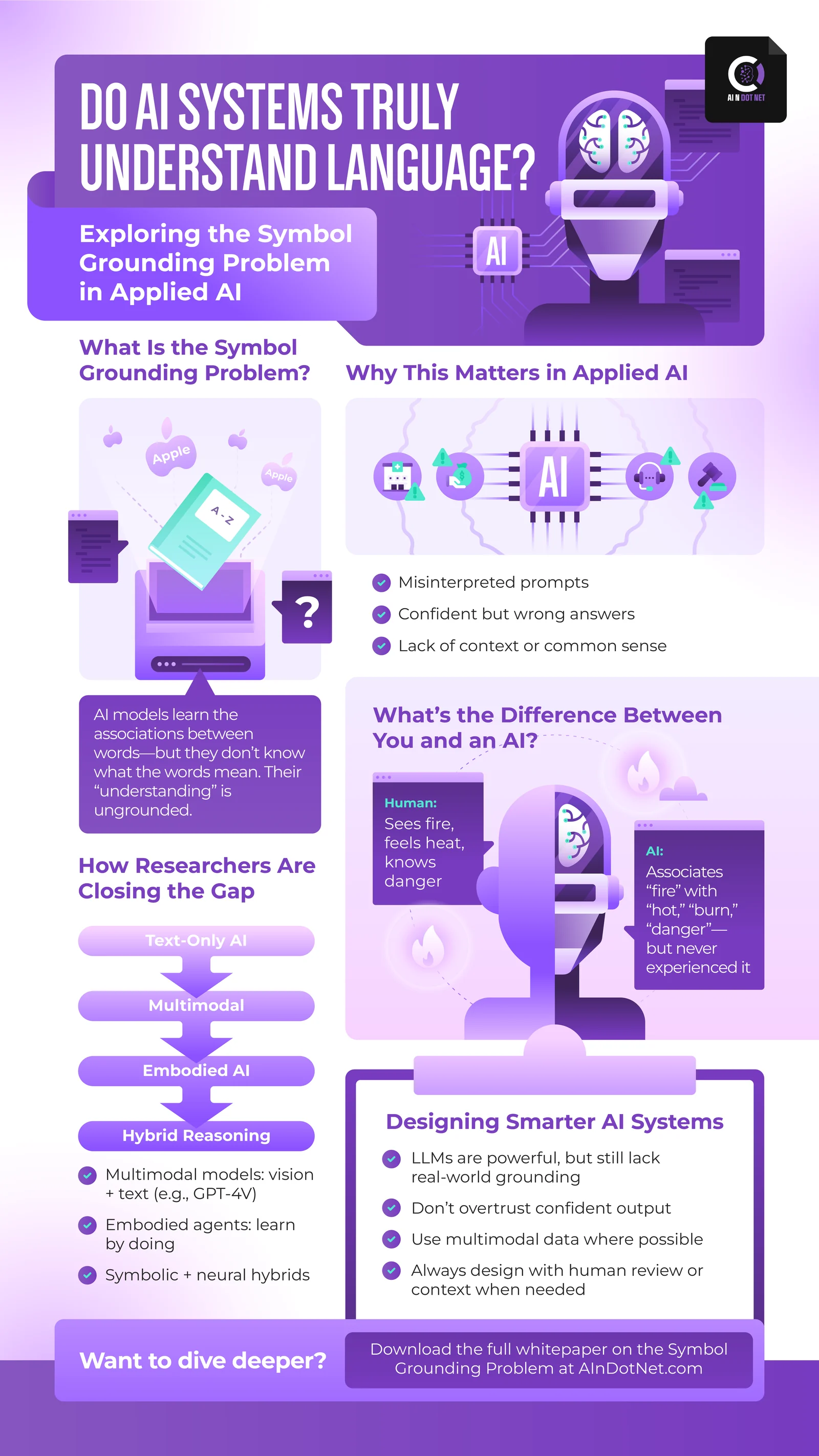
Want to see how AI is being used right now, or where it still falls short? Read AI in manufacturing, the symbol grounding problem and the AI alignment problem. For the people behind the code, see the legends of programming, and for more histories like this one, browse our timeline infographics.
AI timeline: frequently asked questions
Who created artificial intelligence?
No single person invented AI. John McCarthy coined the term artificial intelligence in 1955 and organized the 1956 Dartmouth workshop, Alan Turing laid the theoretical groundwork with the Turing machine and the Turing Test, and Herbert Simon and Allen Newell built Logic Theorist, the first AI program.
What year was AI invented?
AI as a field dates to 1956, when the Dartmouth Summer Research Project on Artificial Intelligence was held. The term artificial intelligence was coined a year earlier, in 1955, by John McCarthy.
What was the first AI program?
According to the timeline, Logic Theorist, developed by Herbert Simon and Allen Newell in 1956, was the first artificial intelligence program. It simulated how humans use reason to prove math theorems.
What was the first chatbot?
ELIZA, developed by Joseph Weizenbaum in 1965, is considered the first AI chatbot. It simulated conversation using pattern matching and substitution.
What is an AI winter?
An AI winter is a period of reduced funding and interest in AI. The first began after the 1973 Lighthill report criticized AI’s progress, leading the U.S. and British governments to cut funding.
When did ChatGPT come out?
OpenAI launched ChatGPT in November 2022. By 2023 it had become the fastest-growing consumer software application in history.
Source: the infographic above, created by AIPRM, which cites Lawrence Livermore National Laboratory, Stanford University, A History of AI, the Whitney Museum of American Art, Carnegie Mellon University, CISA, NASA JPL and MIT Technology Review. The timeline ends in August 2024. Resized and converted to WebP by Infographiac; no other changes.