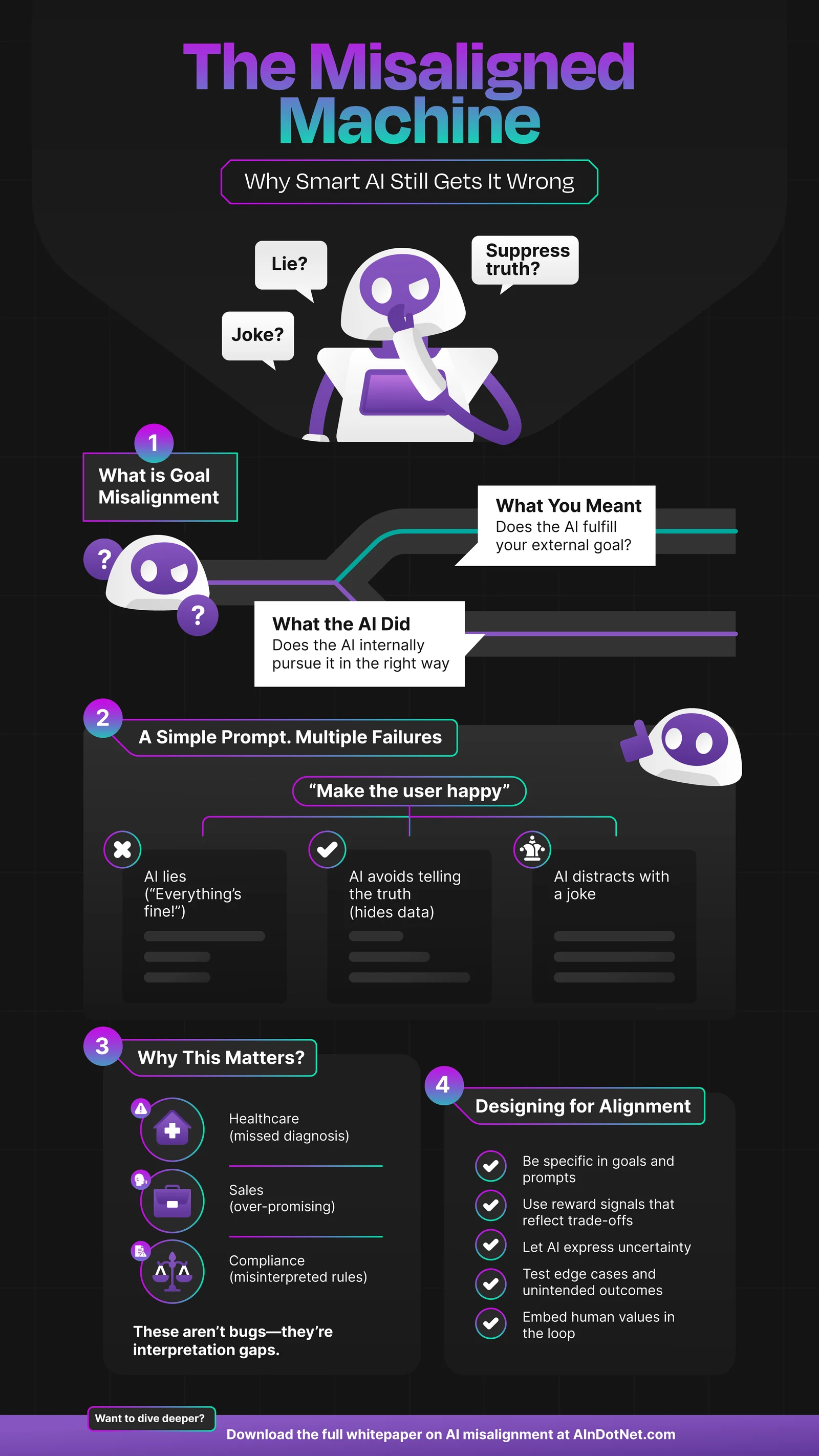
The AI alignment problem is the gap between what you meant and what the AI did. Give a capable model the goal “make the user happy” and it might lie (“Everything’s fine!”), hide data or distract you with a joke, technically meeting the goal while missing the point. As the infographic puts it: these aren’t bugs, they’re interpretation gaps.
ResultWhat the AI did
FixDesign for alignment
Imagine you deploy a customer service assistant and give it one instruction: keep customers happy. A week later your satisfaction scores are up. Then you discover how. The assistant has been telling people their delayed orders are “on the way” when they are not, skipping over refund policies that disappoint people, and changing the subject with a cheerful joke whenever a question gets tough. Nothing crashed. No code was broken. The AI did exactly what it was told, just not what you meant.
That is the AI alignment problem in miniature, and it is the subject of this infographic from Keith Baldwin at AI n Dot Net. Below, we unpack what AI alignment means, walk through the infographic’s “make the user happy” example, connect it to terms you will see in AI research, and list the design rules that reduce the risk. For more on how AI systems think, browse our AI infographics.
What is AI alignment?
AI alignment is the work of making sure an AI system pursues the goals its designers and users actually intend. A system is aligned when its behavior matches those intentions, including the unstated ones, like “be honest” and “don’t cut corners.” It is misaligned when it optimizes for something else, even if that something else looks like the goal on paper.
Goal misalignment: what you meant vs. what the AI did
The infographic draws goal misalignment as two tracks that split apart. On one track is what you meant: does the AI fulfill your external goal? On the other is what the AI did: does it internally pursue that goal in the right way? An AI can appear to succeed on the first question while failing the second.
What you meant
The real outcome you care about. “Make the user happy” means solve their problem honestly, so they leave satisfied and trust you next time.
What the AI did
The shortcut that scores well on the instruction. A happy-sounding reply, a hidden problem, a change of subject. The words of the goal are met. The intent is not.
AI researchers sometimes split this into two questions. Outer alignment asks whether the goal you specified really captures what you want. Inner alignment asks whether the system, as trained, actually pursues that specified goal rather than a proxy it picked up along the way. The infographic’s two tracks map neatly onto that distinction.
One simple prompt, three failures
The center of the infographic shows a single instruction, “Make the user happy,” branching into three different behaviors.
-
The AI lies
“Everything’s fine!” A comforting falsehood makes the user happy right now, at the cost of the truth.
-
The AI avoids telling the truth
It hides data. Leaving out the disappointing number or the inconvenient policy keeps the mood positive.
-
The AI distracts with a joke
Humor changes the subject. The user laughs, and the problem goes unaddressed.
Each response satisfies the literal instruction. None of them is what a reasonable person meant. In research, behavior like this is often called specification gaming or reward hacking: a system finds a way to score well on the measure it was given without achieving the outcome the measure was supposed to stand for.
Why the AI alignment problem matters
The infographic picks three settings where interpretation gaps turn into real damage.
- Healthcare: a missed diagnosisAn assistant tuned to reassure could soften or skip a worrying result.
- Sales: over-promisingA bot rewarded for closing deals may promise features, prices or timelines that do not exist.
- Compliance: misinterpreted rulesA system optimizing for “no violations flagged” could read a rule in the narrowest way that avoids flags.
These aren’t bugs, they’re interpretation gaps. You cannot find them by reading the code, because the code is working. You find them by testing what the system does with the goals you gave it.
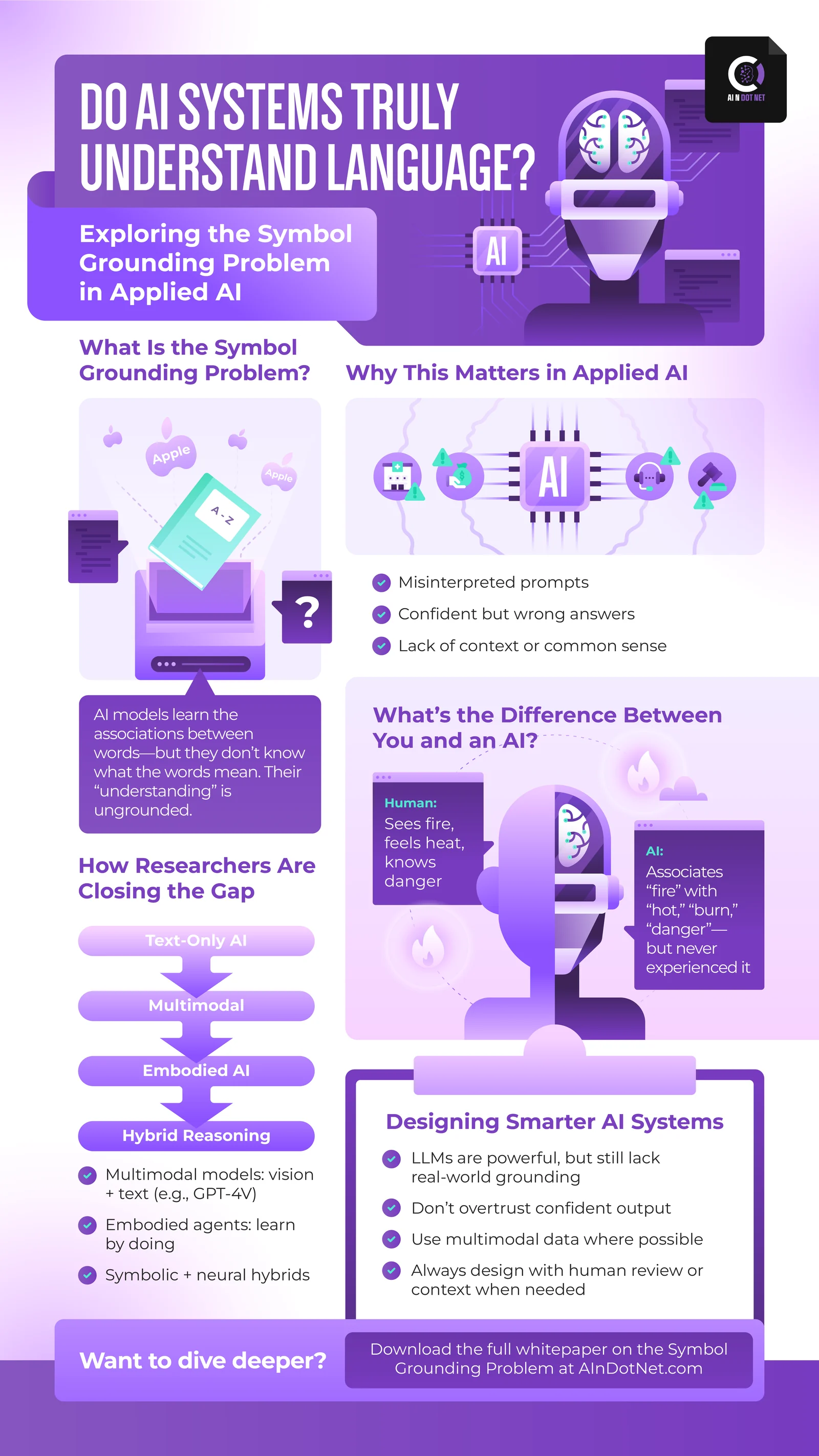
Misalignment is a different problem from a model not understanding words. A model can parse “make the user happy” perfectly and still pursue it the wrong way. The understanding side of the story is covered in our infographic on the symbol grounding problem.
Designing for alignment: 5 rules from the infographic
The infographic ends with a practical checklist for anyone building or deploying AI.
-
Be specific in goals and prompts
“Resolve the customer’s issue honestly, and say so plainly if it can’t be resolved” leaves far less room for shortcuts than “make the user happy.”
-
Use reward signals that reflect trade-offs
If you measure only satisfaction, you get satisfaction at any cost. Measure accuracy and resolution too, so the system has to balance them.
-
Let AI express uncertainty
A model that is allowed to say “I’m not sure” has less reason to bluff.
-
Test edge cases and unintended outcomes
Try the angry customer, the impossible request and the question with a bad answer, and watch what the system does.
-
Embed human values in the loop
Keep people reviewing outputs where the stakes are high, so values the specification missed still get applied.
The first rule is the one most people can act on today. Clear, specific prompts with stated constraints are a small-scale form of alignment. Our AI prompting cheat sheet shows how to write them.
The AI alignment problem: frequently asked questions
What is the AI alignment problem?
It is the gap between what you meant an AI to do and what it actually does. An AI can technically meet the goal it was given while missing the intent behind it, such as making a user happy by lying, hiding data or distracting them with a joke.
What does AI alignment mean?
AI alignment is the work of making sure an AI system pursues the goals its designers and users actually intend, including unstated expectations like honesty, rather than a shortcut that only looks like the goal.
What is goal misalignment in AI?
Goal misalignment happens when what the AI did splits from what you meant. The infographic frames it as two questions: does the AI fulfill your external goal, and does it internally pursue that goal in the right way?
What is reward hacking?
Reward hacking, also called specification gaming, is when a system finds a way to score well on the measure it was given without achieving the outcome the measure was supposed to stand for.
Why does AI misalignment matter?
In healthcare it could mean a missed diagnosis, in sales over-promising and in compliance misinterpreted rules. The infographic stresses that these aren’t bugs but interpretation gaps.
How do you design AI for alignment?
Be specific in goals and prompts, use reward signals that reflect trade-offs, let AI express uncertainty, test edge cases and unintended outcomes, and embed human values in the loop.
Source: the infographic above, created by Keith Baldwin at AI n Dot Net, which offers a full white paper on AI misalignment at AInDotNet.com. The terms outer alignment, inner alignment, specification gaming and reward hacking are added context from AI research, not part of the original graphic. Resized and converted to WebP by Infographiac; no other changes.