Good educational content marketing starts with one question: who is this for? Teachers want time-saving, classroom-ready material in a professional, data-informed tone. Parents want simple, reassuring guidance that fits busy family life. Learners want fun, fast, visual content that helps them test themselves and see progress. One message rarely fits all three.
ParentsReassure me
LearnersKeep it fun
Education brands have a problem most marketers never face: their audience is really three audiences. The teacher choosing classroom resources, the parent deciding what their child should use at home and the student actually doing the learning all see the same brand, often on the same social feed, and they want completely different things from it.
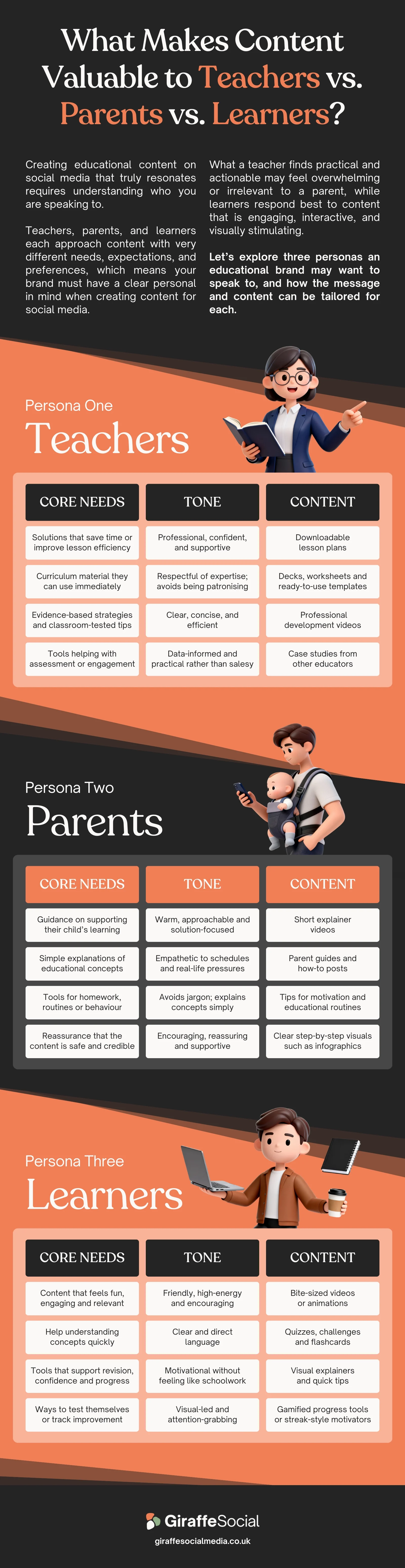
This infographic from Giraffe Social solves that by breaking education marketing into three personas. For each one it lists core needs, the tone that resonates and the content formats that work. As the graphic explains, what a teacher finds practical and actionable may feel overwhelming or irrelevant to a parent, while learners respond best to content that is engaging, interactive and visually stimulating. Below, we turn the three persona cards into a side-by-side comparison you can plan from. For more visual guides like this, see our SEO and marketing infographics.
Education marketing starts with the persona
Creating educational content on social media that truly resonates requires understanding who you are speaking to. Teachers, parents and learners each approach content with different needs, expectations and preferences, so a brand needs a clear persona in mind before it writes a single post. The rest of this page follows the infographic’s three personas in order.
Persona 1: what teachers value in educational content
Teachers are busy professionals. The infographic’s teacher persona wants content that respects their expertise and gives them something they can use in class tomorrow.
- Core needsSolutions that save time or improve lesson efficiency. Curriculum material they can use immediately. Evidence-based strategies and classroom-tested tips. Tools that help with assessment or engagement.
- ToneProfessional, confident and supportive. Respectful of expertise and never patronising. Clear, concise and efficient. Data-informed and practical rather than salesy.
- Content that worksDownloadable lesson plans. Decks, worksheets and ready-to-use templates. Professional development videos. Case studies from other educators.
The common thread is utility. A post that says “here are three ways to check understanding in a five-minute plenary, with a free template” will outperform a polished brand video for this audience every time.
Persona 2: what parents value
Parents come to educational content with a different worry: am I helping my child, and can I trust this? The infographic’s parent persona needs plain language and reassurance.
- Core needsGuidance on supporting their child’s learning. Simple explanations of educational concepts. Tools for homework, routines or behaviour. Reassurance that the content is safe and credible.
- ToneWarm, approachable and solution-focused. Empathetic to schedules and real-life pressures. Avoids jargon and explains concepts simply. Encouraging, reassuring and supportive.
- Content that worksShort explainer videos. Parent guides and how-to posts. Tips for motivation and educational routines. Clear step-by-step visuals such as infographics.
That last point is worth noticing. The infographic itself recommends infographics for parents, because a clear visual answers “what do I actually do tonight?” faster than a long article. There is good reason visuals stick, which we cover in why your brain remembers infographics.
Persona 3: what learners value
Learners are the end users, and they are the least patient audience of the three. The infographic’s learner persona wants content that does not feel like schoolwork.
- Core needsContent that feels fun, engaging and relevant. Help understanding concepts quickly. Tools that support revision, confidence and progress. Ways to test themselves or track improvement.
- ToneFriendly, high-energy and encouraging. Clear and direct language. Motivational without feeling like schoolwork. Visual-led and attention-grabbing.
- Content that worksBite-sized videos or animations. Quizzes, challenges and flashcards. Visual explainers and quick tips. Gamified progress tools or streak-style motivators.
Teachers vs. parents vs. learners: side-by-side comparison
Here is the whole infographic condensed into one table, so you can see how the same brand should sound different to each audience.
| Teachers | Parents | Learners | |
|---|---|---|---|
| Main need | Save time, classroom-ready material | Support their child with confidence | Understand fast and see progress |
| Tone | Professional, data-informed, not salesy | Warm, jargon-free, reassuring | Friendly, high-energy, visual-led |
| Proof they want | Evidence and classroom-tested tips | Safe, credible sources | Ways to test themselves |
| Best formats | Lesson plans, templates, PD videos, case studies | Explainer videos, how-to guides, step-by-step visuals | Short videos, quizzes, flashcards, streaks |
How to put this into your educational content strategy
The infographic gives you the personas. Turning them into a content plan takes four steps.
-
Label every post with its persona
Before you write, decide who the post is for. If the answer is “everyone,” it will probably land with no one.
-
Match the format to the audience
Templates and case studies for teachers, guides and explainers for parents, quizzes and short videos for learners. Reuse one idea across all three by changing the format, not just the caption.
-
Adjust the tone, not the facts
The same research finding can be a data point for a teacher, a reassurance for a parent and a challenge for a learner. Keep the substance consistent and change the voice.
-
Pick platforms where each persona already is
Usage differs sharply by age. Our infographics on how adults and teens use social media and AI and Millennials vs. Gen Z are useful when you decide where parents and students will see you.
Why visual content matters in education marketing
Two of the three personas ask for visuals directly: parents want step-by-step visuals such as infographics, and learners want visual explainers and visual-led content. A well-made infographic also works for teachers as a ready-to-use classroom resource. If you are an education brand building your own visual content, infographics can do double duty as marketing and as backlinks. Our guestographics guide explains how, and you can submit your infographic to Infographiac for review.
Educational content marketing: frequently asked questions
What makes educational content valuable to teachers?
Teachers value content that saves time or improves lesson efficiency, curriculum material they can use immediately, evidence-based classroom-tested tips and tools for assessment or engagement, delivered in a professional, data-informed tone that is not salesy.
What kind of educational content do parents want?
Parents want guidance on supporting their child’s learning, simple explanations of educational concepts, tools for homework and routines, and reassurance that content is safe and credible. Short explainer videos, how-to guides and step-by-step visuals such as infographics work well.
What educational content works best for students?
Learners respond to content that feels fun, engaging and relevant, such as bite-sized videos, quizzes, challenges, flashcards, visual explainers and gamified progress tools or streak-style motivators.
What tone should education brands use on social media?
It depends on the persona. Use a professional, concise, data-informed tone for teachers, a warm, jargon-free and reassuring tone for parents, and a friendly, high-energy, visual-led tone for learners.
Why should education marketers create different content for each audience?
Teachers, parents and learners approach content with different needs and preferences. What a teacher finds practical and actionable may feel overwhelming or irrelevant to a parent, while learners respond best to engaging, interactive and visual content.
Source: the infographic above, created and published by Giraffe Social (giraffesocialmedia.co.uk). Resized and converted to WebP by Infographiac; no other changes.