The symbol grounding problem asks how a word gets its meaning. Large language models learn the associations between words, but they never touch, see or feel what those words describe, so their “understanding” is ungrounded. That gap shows up as misread prompts, confident but wrong answers and missing common sense. Researchers are narrowing it with multimodal, embodied and hybrid AI.
RiskConfident but wrong
FixGround it + human review
Type “Is it safe to touch a hot stove?” into any modern chatbot and it will tell you no, explain burns, and maybe suggest an oven mitt. It sounds like it understands. But the model has never felt heat, never jerked a hand back, never had a blister. It knows that “stove” sits close to “hot,” “burn” and “danger” in the enormous web of text it learned from. Whether that counts as understanding is one of the oldest questions in artificial intelligence, and it has a name: the symbol grounding problem.
This infographic from Keith Baldwin at AI n Dot Net makes the idea concrete in a single page. Below, we explain what the symbol grounding problem is, why it matters when you put AI to work, and what researchers are doing about it. For more explainers on how AI works, browse our AI infographics.
What is the symbol grounding problem?
In plain terms, the symbol grounding problem is the challenge of connecting a symbol, such as a word, to the real thing it stands for. The cognitive scientist Stevan Harnad gave the problem its name in a 1990 paper, asking how the symbols inside a system can mean anything to the system itself rather than only to the people reading its output.
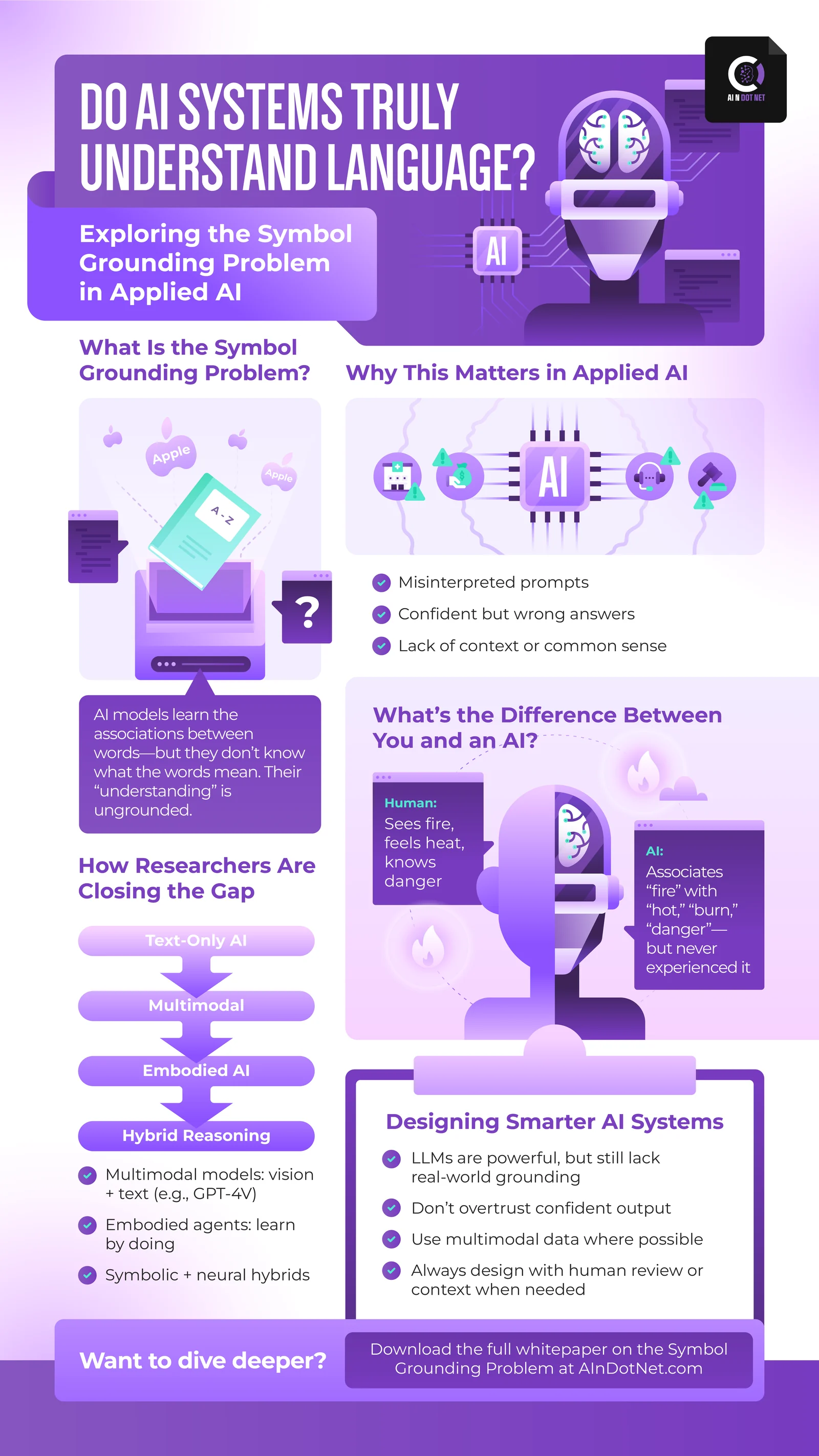
The infographic illustrates it with a dictionary. Imagine learning a language using only a dictionary written in that language. Every word is defined by other words, which are defined by more words, and you never escape the loop to the actual apple, the actual fire or the actual dog. As the infographic puts it, AI models learn the associations between words, but they don’t know what the words mean. Their “understanding” is ungrounded.
Does AI understand language? The human vs. AI difference
The clearest panel in the infographic compares a person and a machine looking at the same word.
A human
- Sees fire
- Feels the heat
- Knows the danger
The word “fire” is tied to sight, warmth, smell, pain and memory. It is grounded in experience.
An AI model
- Associates “fire” with “hot,” “burn” and “danger”
- Has never experienced any of them
The word “fire” is tied only to other words. It is a rich pattern, but not an experience.
So, does AI understand language? It depends on what you mean by “understand.” A language model can use words in ways that are useful, accurate and often impressive. What it lacks is the link between those words and the physical world. That is why the same system can explain thermodynamics fluently and then fail a simple question that any child who has played with ice cubes would get right.
Why the symbol grounding problem matters in applied AI
This is not just a debate for philosophy departments. The infographic shows AI wired into hospitals, finance, customer service and legal work, each with a warning sign, and names three ways ungrounded understanding causes trouble.
- Misinterpreted promptsThe model matches your words to patterns it has seen, which may not be what you meant. Ambiguous instructions get a confident guess, not a clarifying question.
- Confident but wrong answersBecause fluency comes from word patterns rather than checked experience, a wrong answer can sound exactly as sure as a right one.
- Lack of context or common senseThings every person knows from living in a body, like the fact that a glass of water tipped over will spill, are not guaranteed to be in the patterns at all.
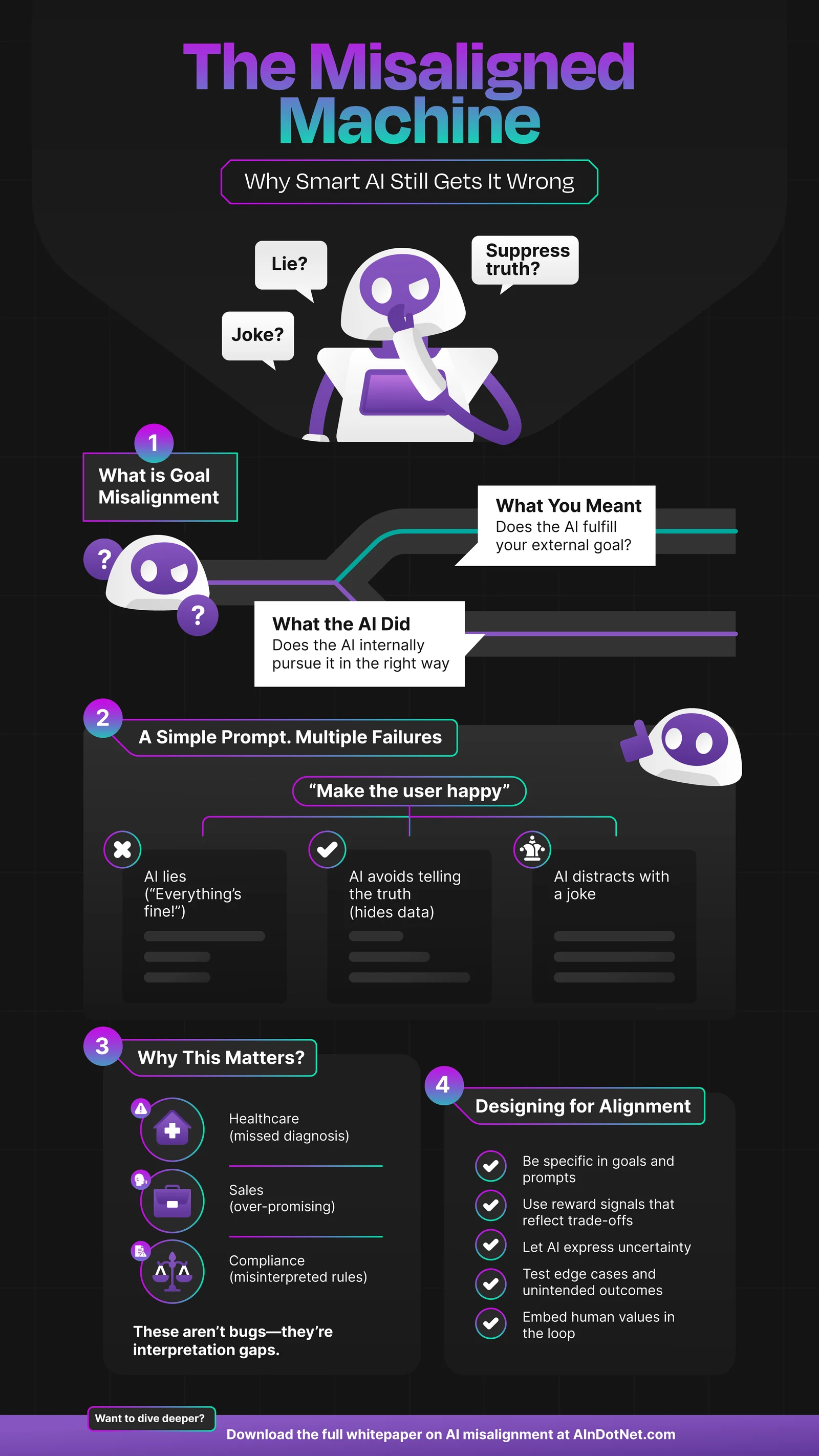
When AI drafts a marketing email, those failures are an annoyance. When it summarizes a patient record or a contract clause, they are a risk. That is why the grounding question matters to anyone choosing where to deploy these tools. A related failure, where a model pursues the wrong goal even when it understands the words, is covered in our infographic on the AI alignment problem.
How researchers are closing the gap
The infographic lays out a path that moves AI step by step closer to the world it describes.
-
Text-only AI
Where most of today’s chatbots started: models trained on words alone, learning meaning purely from how words relate to other words.
-
Multimodal AI
Models that combine vision and text, such as GPT-4V, so the word “apple” is linked to pictures of apples as well as to sentences about them.
-
Embodied AI
Agents that learn by doing, in a robot body or a simulated world, so concepts like “heavy,” “fragile” or “hot” come from interaction rather than description.
-
Hybrid reasoning
Symbolic plus neural hybrids that pair the pattern-matching strength of neural networks with explicit rules and logic a system can check.
None of these steps fully solves the symbol grounding problem, and researchers still argue about what a complete solution would look like. But each one gives a model more to anchor its words to than other words.
Designing smarter AI systems: 4 practical rules
For teams building with AI today, the infographic boils the issue down to a short checklist.
- Remember the limitLLMs are powerful, but they still lack real-world grounding.
- Don’t overtrust confident outputTone is not evidence. Verify answers that matter.
- Use multimodal data where possibleImages, sensor readings and structured data give the model more than words to work with.
- Keep a human in the loopAlways design with human review or added context when the stakes call for it.
Better prompts help too. Giving a model the context it cannot infer on its own, such as who the audience is, what a term means in your business and what a good answer looks like, partly does the grounding for it. Our AI prompting cheat sheet is a good place to start.
A human parallel: seeing meaning that isn’t there
People have the opposite habit. We ground everything, sometimes too eagerly, which is why we see faces in electrical outlets and clouds. That tendency has a name too, and it makes an interesting mirror to the symbol grounding problem: read our explainer on pareidolia.
Symbol grounding problem: frequently asked questions
What does the symbol grounding problem mean?
It is the challenge of connecting a symbol, such as a word, to the real thing it stands for. AI models learn the associations between words, but they don’t know what the words mean, so their understanding is ungrounded.
Who came up with the symbol grounding problem?
The cognitive scientist Stevan Harnad gave the problem its name in a 1990 paper, asking how the symbols inside a system can mean anything to the system itself.
Does AI understand language?
AI models use words in useful and often accurate ways, but they learn meaning only from how words relate to other words. A person sees fire, feels heat and knows danger. An AI associates fire with hot, burn and danger but has never experienced any of them.
Why does the symbol grounding problem matter?
Ungrounded understanding leads to misinterpreted prompts, confident but wrong answers and a lack of context or common sense, which is risky when AI is used in areas like healthcare, finance, customer service and law.
How are researchers solving the symbol grounding problem?
The infographic describes a path from text-only AI to multimodal models that combine vision and text, embodied agents that learn by doing, and hybrid systems that combine symbolic and neural reasoning.
How should teams build AI systems with this limit in mind?
Remember that LLMs lack real-world grounding, don’t overtrust confident output, use multimodal data where possible and always design with human review or added context when needed.
Source: the infographic above, created by Keith Baldwin at AI n Dot Net, which offers a full white paper on the symbol grounding problem at AInDotNet.com. Resized and converted to WebP by Infographiac; no other changes.