This infographic turns the S&P 500 companies list into a timeline, placing every current member in the year and month it joined the index. 53 of today’s companies date back to the index’s launch in March 1957, including 3M, Coca-Cola, IBM and Procter & Gamble. Big names arrived much later: Apple in 1982, Microsoft in 1994, Amazon in 2005, Tesla in 2020 and Palantir in 2024.
Original members still in53
Data throughDecember 2024
The S&P 500 feels permanent, but its membership changes all the time. Companies are added as they grow and removed as they shrink, merge or get acquired. That means the list of S&P 500 companies is really a record of which businesses rose to the top of the U.S. economy, and when.
This infographic from Madison Trust Company lays that record out as a single timeline. Every company in the index as of December 2024 appears under the year and month it joined, with a colored border showing its sector. Below, we pull out the milestones, list when famous companies were added and explain what the pattern says about how the economy has changed. For more history told through graphics, browse our timeline infographics.
How to read the S&P 500 timeline
Each year on the timeline lists the companies added that year, grouped by month. A strip of colored bars beside each year shows the mix of sectors that joined. The infographic uses twelve sector colors, covering energy, utilities, consumer staples, communication services, consumer discretionary, materials, financials, real estate, industrials, information technology, health care and one more category labeled single-family.
One thing the timeline does not show is the companies that left. It lists only the current members, so years with few entries are not years when the index stood still. They are years whose additions have mostly since dropped out.
The 1957 originals: 53 companies still in the index
The S&P 500 launched in March 1957, and the infographic shows 53 companies on today’s list that date to that first lineup. They read like a roll call of 20th-century American industry.
- Consumer staplesCoca-Cola, PepsiCo, Procter & Gamble, Colgate-Palmolive, Kimberly-Clark, Hershey, General Mills, Campbell Soup, Kroger, Altria, Archer Daniels Midland
- Industrials and aerospace3M, Boeing, Caterpillar, Deere, Honeywell, Lockheed Martin, General Dynamics, Northrop Grumman, RTX, GE Aerospace, Eaton, Union Pacific, CSX, Norfolk Southern
- EnergyExxonMobil, Chevron, ConocoPhillips, Occidental Petroleum, Halliburton, Schlumberger
- Health careAbbott Laboratories, Merck, Pfizer, Bristol Myers Squibb, CVS Health
- UtilitiesAmerican Electric Power, Con Edison, CMS Energy, DTE Energy, Edison International, Entergy, Exelon, PSEG, Southern Company, Xcel Energy
- Everything elseIBM, Ford, Motorola Solutions, PPG Industries, International Paper, The Hartford and S&P Global
When were famous companies added to the S&P 500?
The questions people search for most are about specific companies. Here are the join dates the infographic shows for some of the biggest names.
| Company | Added to the S&P 500 |
|---|---|
| McDonald’s | June 1970 |
| Johnson & Johnson | June 1973 |
| JPMorgan Chase | June 1975 |
| Walt Disney | June 1976 |
| Intel | December 1976 |
| Walmart | August 1982 |
| Apple | November 1982 |
| The Home Depot | March 1988 |
| Costco | October 1993 |
| Microsoft | June 1994 |
| Starbucks | June 2000 |
| Nvidia | November 2001 |
| Amazon | November 2005 |
| Alphabet (Class C) | April 2006 |
| Visa | December 2009 |
| Berkshire Hathaway | February 2010 |
| Netflix | December 2010 |
| Meta Platforms | December 2013 |
| Tesla | December 2020 |
| Uber | December 2023 |
| Palantir | September 2024 |
S&P 500 history, decade by decade
- 1950s and 1960s
After the 1957 launch, only a handful of today’s members join in the next decade, including Sherwin-Williams (1964), Emerson Electric and Cummins (1965), and Clorox and Newmont (1969).
- 1970s
Consumer and financial names arrive: McDonald’s and Eli Lilly (1970), Johnson & Johnson (1973), HP (1974), JPMorgan Chase (1975). 1976 is one of the busiest years of the decade, adding Bank of America, Wells Fargo, American Express, Disney, Duke Energy, NextEra, Cigna, Molson Coors, Target and Intel.
- 1980s
Retail and technology rise. FedEx (1980), Walmart and Apple (1982), Verizon and AT&T (1983), Lowe’s (1984), Medtronic (1986), Home Depot, Citigroup and Nike (1988), and Oracle (1989).
- 1990s
The tech boom shows up in the colors. Amgen (1992), Cisco and Costco (1993), Microsoft (1994), Applied Materials (1995), Adobe and Charles Schwab (1997), and Qualcomm and Best Buy (1999).
- 2000s
Starbucks and Intuit (2000), Nvidia and Texas Instruments (2001), Goldman Sachs, UPS and eBay (2002), Amazon (2005), Alphabet (2006), and a packed 2008 that includes Philip Morris International, Mastercard, Salesforce and Intuitive Surgical. Visa arrives in 2009.
- 2010s
Berkshire Hathaway and Netflix (2010), BlackRock and Chipotle (2011), AbbVie (2012), Meta (2013), Broadcom (2014), PayPal (2015), Charter (2016), AMD (2017), Take-Two and Arista (2018), and T-Mobile and ServiceNow (2019).
- 2020 to 2024
Tesla, Domino’s and Dexcom (2020), Moderna (2021), Warner Bros. Discovery and First Solar (2022), Airbnb, Uber and Blackstone (2023), and a 2024 class of Supermicro, GE Vernova, KKR, CrowdStrike, Palantir, Dell, Workday and Apollo Global Management.
What the timeline says about the U.S. economy
- Industry first, tech laterThe 1957 originals are dominated by energy, utilities, manufacturing and consumer staples. Information technology barely appears until the 1980s and 1990s.
- Giants join lateSeveral of the largest companies by market value today, including Amazon, Alphabet, Meta and Tesla, joined in 2005 or later.
- Survivors are rareOnly 53 companies from the original 1957 lineup remain on the list, which shows how much turnover a “permanent” index really has.
- Recent years are crowdedThe timeline gets noticeably denser after 2015, reflecting a faster churn of new companies in and older ones out.
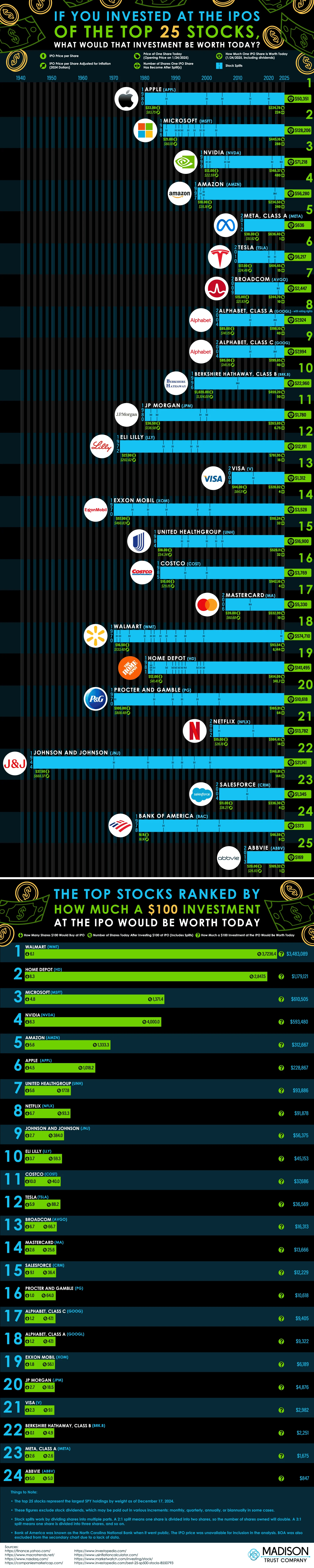
Joining the index and making shareholders rich are different stories. For what an investment at the IPO in today’s biggest S&P 500 stocks would be worth now, see our companion piece, If You Invested at the IPO: What 25 Top Stocks Are Worth Today. For brands that have changed their look as they grew, try the evolution of a logo.
S&P 500 companies: frequently asked questions
When did the S&P 500 start?
The S&P 500 launched in March 1957. The infographic shows 53 of today’s companies that date back to that original lineup, including 3M, Coca-Cola, IBM, ExxonMobil and Procter & Gamble.
When was Apple added to the S&P 500?
According to the timeline, Apple was added to the S&P 500 in November 1982.
When was Tesla added to the S&P 500?
Tesla joined the S&P 500 in December 2020.
When was Nvidia added to the S&P 500?
Nvidia was added to the S&P 500 in November 2001.
When were Amazon and Microsoft added to the S&P 500?
Microsoft joined in June 1994 and Amazon in November 2005.
Which companies were added to the S&P 500 in 2024?
The 2024 additions on the timeline are Supermicro, Deckers Brands, Solventum, GE Vernova, Vistra, GoDaddy, KKR, CrowdStrike, Smurfit WestRock, Erie Indemnity, Palantir, Dell Technologies, Texas Pacific Land, Lennox International, Workday and Apollo Global Management.
Source: the infographic above, created by Madison Trust Company using Wikipedia’s List of S&P 500 companies, reflecting index membership through December 2024. Membership changes regularly, so check a current list for today’s constituents. This page is general information only and is not financial advice. Resized and converted to WebP by Infographiac; no other changes.