To make a monthly budget, start with your take-home pay, split it with the 50/30/20 rule (50% needs, 30% wants, 20% savings and extra debt payments), track every purchase for a month, protect a little fun money, automate your savings on payday, and check in once a month. Then build an emergency fund in two stages: $1,000 first, then 3 to 6 months of living expenses.
Most people do not skip budgeting because they do not care about money. They skip it because the usual advice starts with a 14-tab spreadsheet and a lecture about lattes. By week two, the spreadsheet is abandoned and nothing has changed.
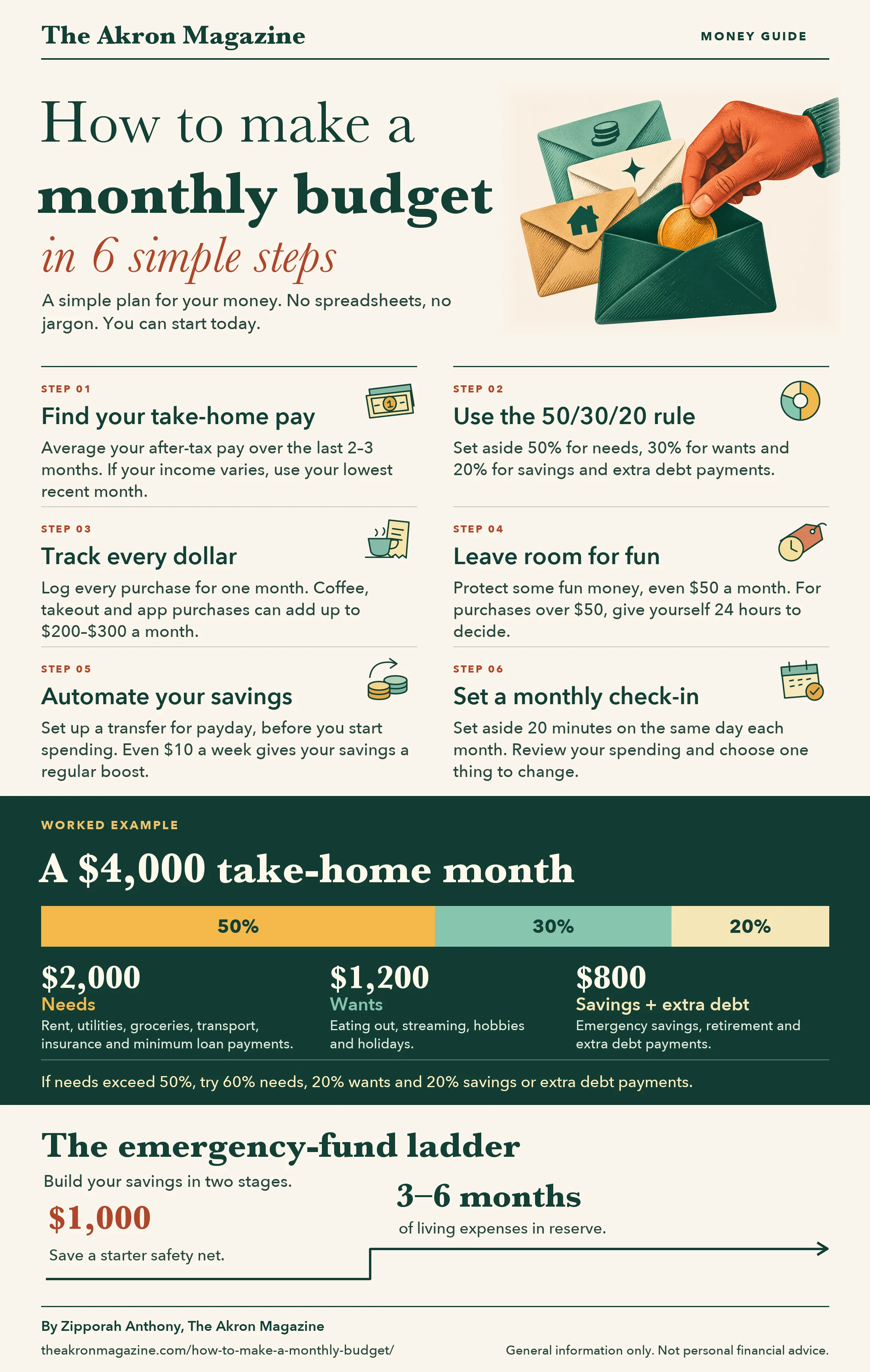
This infographic takes the opposite approach. It comes from Zipporah Anthony at The Akron Magazine, whose full guide, How to Make a Monthly Budget That Actually Works, goes deeper on each step. The idea is simple: no spreadsheets, no jargon, and a plan you can start today. Below, we walk through all six steps, run the numbers on a real month, and answer the budgeting questions people ask most.
How to make a monthly budget in 6 simple steps
-
Find your take-home pay
Your budget is built on what actually lands in your account, not your salary. Average your after-tax pay over the last 2 to 3 months to smooth out any odd paychecks.
If your income varies, from freelancing, tips, commission or seasonal work, use your lowest recent month instead. Budgeting on a bad month means a good month becomes a bonus, not a bailout.
-
Use the 50/30/20 rule
Split that take-home number three ways:
- 50% for needs: rent, utilities, groceries, transport, insurance and minimum loan payments
- 30% for wants: eating out, streaming, hobbies and holidays
- 20% for savings and extra debt payments: emergency savings, retirement and anything above the minimum on your debts
-
Track every dollar
Log every purchase for one month. Not forever, just one month. It is the fastest way to find out where your money really goes, because small spending hides well. Coffee, takeout and app purchases can quietly add up to $200 to $300 a month.
Try it for 30 days -
Leave room for fun
A budget with zero fun in it does not last. Protect some fun money, even $50 a month, so you are not tempted to blow the whole plan on a bad day.
For anything over $50, give yourself 24 hours to decide. If you still want it tomorrow, buy it guilt-free. If you forgot about it, you just saved the money.
The 24-hour rule -
Automate your savings
Set up an automatic transfer for payday, so savings leave your account before you start spending. Money you never see is money you do not miss.
The amount matters less than the habit. Even $10 a week adds up to $520 over a year and gives your savings a regular boost.
-
Set a monthly check-in
Set aside 20 minutes on the same day each month. Review what you spent, compare it to the plan, and choose just one thing to change next month. One change a month is 12 improvements a year, without the overwhelm.
20 minutes a month
The 50/30/20 rule on a $4,000 take-home month
The infographic works through a real example. Here is how a $4,000 month after tax splits under the 50/30/20 rule.
| Bucket | Share | Amount | What it covers |
|---|---|---|---|
| Needs | 50% | $2,000 | Rent, utilities, groceries, transport, insurance and minimum loan payments |
| Wants | 30% | $1,200 | Eating out, streaming, hobbies and holidays |
| Savings + extra debt | 20% | $800 | Emergency savings, retirement and extra debt payments |
To run your own numbers, multiply your take-home pay by 0.5, 0.3 and 0.2. On $3,000 a month, that is $1,500 for needs, $900 for wants and $600 for savings and extra debt.
What if your needs are more than 50%?
In a lot of cities, rent alone can eat half a paycheck, so a strict 50% for needs is not realistic for everyone. The infographic’s fix: if your needs run over 50%, try 60% needs, 20% wants and 20% savings or extra debt payments. Wants give up 10 points so your savings rate stays intact.
| Split on $4,000 | Needs | Wants | Savings + extra debt |
|---|---|---|---|
| 50/30/20 | $2,000 | $1,200 | $800 |
| 60/20/20 | $2,400 | $800 | $800 |
The emergency fund ladder: build savings in two stages
The last section of the infographic turns “save more” into two clear targets. Hitting the first one fast is what keeps you going toward the second.
- Stage 1: $1,000Save a starter safety net first. It covers the surprise car repair or vet bill that would otherwise land on a credit card. At $800 a month in savings, as in the example above, you get there in about five or six weeks.
- Stage 2: 3 to 6 monthsThen keep climbing until you hold 3 to 6 months of living expenses in reserve. If your essential costs are $2,000 a month, that is a target of $6,000 to $12,000.
Good to know before you start
- Percentages are a starting pointThe 50/30/20 split is a guide, not a law. Adjust it to your life, then use your monthly check-in to nudge it.
- Minimums are needs, extras are savingsMinimum loan payments belong in needs. Anything you pay above the minimum comes out of the 20%.
- Automate before you spendThe payday transfer in step 5 is what makes the 20% actually happen, so set it up first.
- One change at a timeTrying to fix every habit in month one is how budgets die. Pick one thing, fix it, move on.
How to make a monthly budget: frequently asked questions
How do I make a monthly budget?
Find your take-home pay, split it with the 50/30/20 rule, track every purchase for one month, leave room for fun money, automate your savings on payday, and set a 20-minute monthly check-in to review your spending and choose one thing to change.
What is the 50/30/20 rule?
It is a simple way to split your take-home pay: 50% for needs, 30% for wants and 20% for savings and extra debt payments. On a $4,000 take-home month, that is $2,000 for needs, $1,200 for wants and $800 for savings and extra debt.
What if my needs are more than 50% of my income?
Try 60% for needs, 20% for wants and 20% for savings or extra debt payments. Wants give up 10 points so your savings rate stays intact.
What income should I budget with if my pay varies?
Use your lowest recent month. If your income is steady, average your after-tax pay over the last 2 to 3 months.
How much should I have in an emergency fund?
Build it in two stages. Save a $1,000 starter safety net first, then keep going until you hold 3 to 6 months of living expenses in reserve.
How often should I review my budget?
Once a month. Set aside 20 minutes on the same day each month, review your spending and choose one thing to change.
Source: the infographic above, created and submitted by The Akron Magazine. This page is general information only and is not personal financial advice.